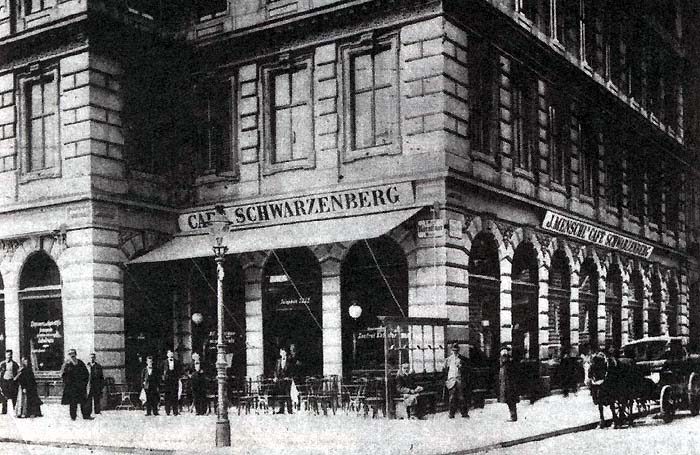
A Ringstrasse Coffeehouse Since 1861
Café Schwarzenberg opened in 1861 at Kärntner Ring 17, in the year Vienna's grand Ringstrasse boulevard began to take shape near what is now Schwarzenbergplatz. The building was commissioned by the silk merchant and court supplier Albrecht Zeppezauer, and it was there that Mr and Mrs Hochleitner opened the café that would, over the following decades, pass through several names and owners.
Known first as Café Hochleitner and later as Café Sperrer, the coffeehouse only took the name Café Schwarzenberg in 1902, when it was taken over by Josef Menschl. Between 1939 and 1945, during the Nazi occupation of Austria, it operated under the name Café Deutschland. After the war, Soviet army officers used the premises and damaged the interior with gunfire; a mirror struck by bullets during this period had its cracks and holes disguised with decorative vine and floral motifs, a repair that remained visible until renovation work in 1979.
A Threatened Closure and a Rescue
By the late 1970s the café's future was in doubt. In 1978 its owner considered closing it to sell the premises to a car dealership. The plan was stopped through the intervention of Dr Helmut Zilk, at the time Vienna's city councillor for culture and later its mayor, and the café underwent a full renovation in 1979, reopening under new management in 1980.
Architecture and Regulars
Café Schwarzenberg is one of the last surviving examples of the coffeehouse culture that once lined the Ringstrasse, which counted more than thirty such cafés at its height. Its interior still carries decorative elements from the renovations of the interwar period, recognised and protected by Austria's federal monuments office.
The café was never a centre of Vienna's bohemian scene in the way some of its rivals were, but it drew its own regulars. The architect Josef Hoffmann, founder of the Wiener Werkstätte design workshop, was among its most frequent guests, reportedly arriving for lunch, reading the newspapers and sketching ideas for his projects on the café's paper place mats. Other visitors over the decades included the painter Hermann Nitsch and the actress Adrienne Gessner, alongside figures from Vienna's political and business circles.
Café Schwarzenberg Today
The café continues to operate in the same rooms, offering the standard repertoire of a Viennese coffeehouse: a wide selection of coffee, pastries such as Sachertorte and Apfelstrudel, and simple local dishes, served in an interior that keeps its early twentieth-century character rather than following the more casual, informal look adopted by many newer cafés in the city. It remains a working café rather than a museum piece, but its position on the Ringstrasse, and its list of past regulars, keep it tied to the wider history of Vienna's coffeehouse tradition.