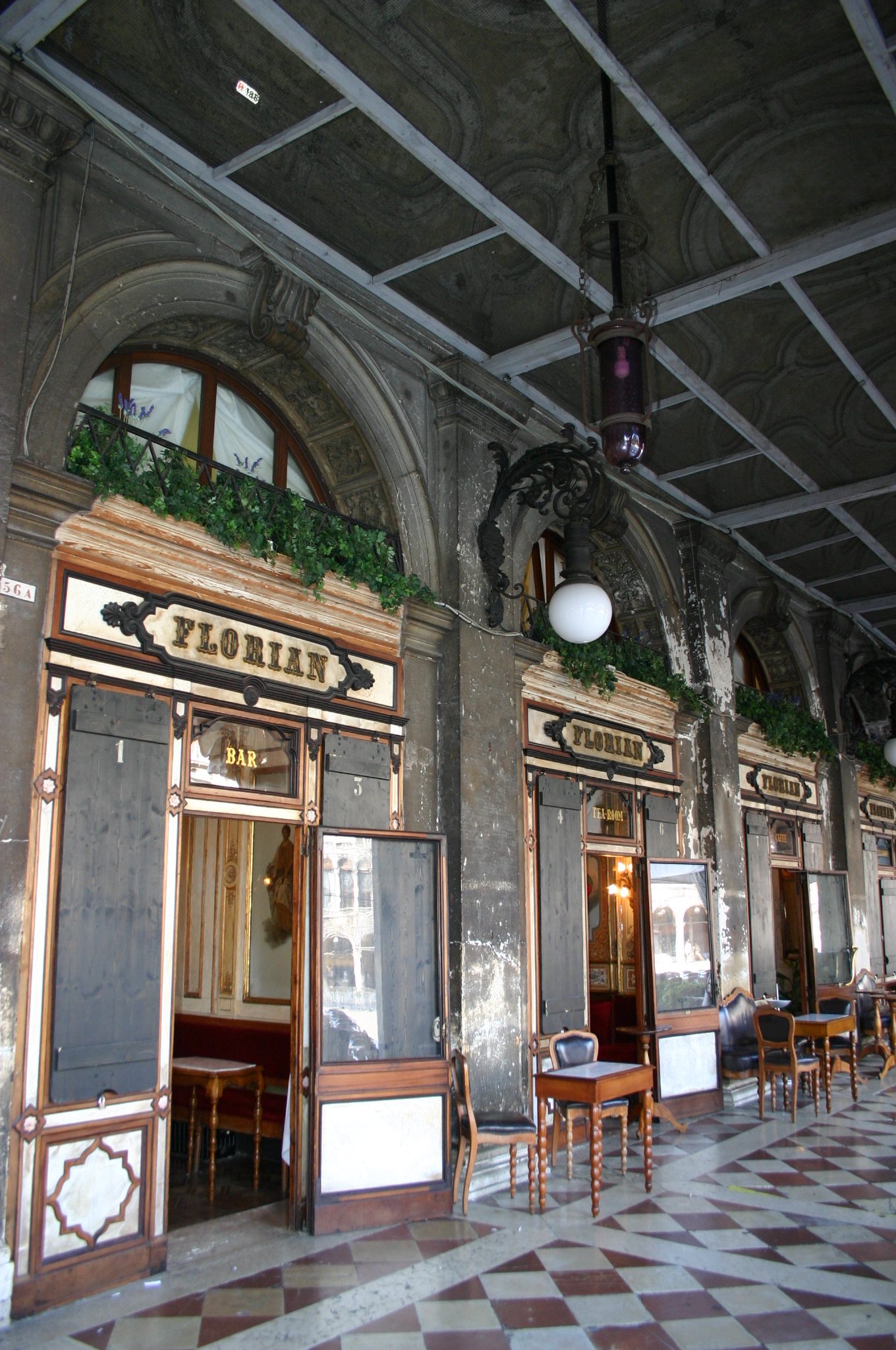
A Venetian café since 1720
Caffè Florian opened in Piazza San Marco on 29 December 1720, under the name 'Alla Venezia Trionfante'. It later took the name of its proprietor, Floriano Francesconi, and is recognised as the oldest coffee house in continuous operation in Italy. Its position on the piazza, under the arcades facing the Basilica, made it a natural meeting place for Venetian society from its earliest years, at a time when coffee houses were still a relatively new fixture of European city life.
Patrons across three centuries
Over the following centuries the café drew a long list of writers, artists and travellers. Carlo Goldoni, a regular, is said to have drawn inspiration here for his comedy 'La bottega del caffè', and Giacomo Casanova was among its early patrons. Later visitors included Ugo Foscolo, Lord Byron, Goethe, Charles Dickens and Marcel Proust; Florian was also known as one of the few Venetian cafés that admitted women in the eighteenth century, adding to its role as a genuine public meeting place rather than a men-only club. During the 1848 uprising against Austrian rule, the café served Venetian patriots and was used at times as a makeshift hospital, a role that placed it briefly at the centre of the city's political life as well as its social one.
An interior built up over generations
Florian's rooms were not decorated all at once. Following an 1858 restoration by the architect Lodovico Cadorin, the café was expanded with a sequence of themed rooms, including the Sala Orientale and the Sala degli Uomini Illustri, its walls hung with portraits of notable Venetians, and later the Sala Cinese. A Liberty-style room in the Art Nouveau taste was added in 1920, giving the café its present sequence of small, individually decorated salons rather than a single grand hall. Mirrors, carved wood panelling, gilded stucco and period upholstery furnish the rooms, giving each a distinct character while preserving a shared nineteenth-century idiom.
A link to the Biennale
Since 1893 Florian has been associated with the Venice Biennale, and since 1988 it has periodically hosted contemporary art exhibitions tied to the Biennale programme, connecting its historic rooms to Venice's ongoing role as a centre for contemporary art as well as its eighteenth-century past. This arrangement means the café's decorated salons, largely fixed in their nineteenth-century form, periodically display work by contemporary artists alongside the portraits and gilding of an earlier era.
Florian today
The café continues to operate from the same arcaded premises on Piazza San Marco, serving pastries made on site and coffee blends sold for visitors to take home, alongside outdoor seating under the portico that looks onto the square. Its combination of an unbroken three-century trading history and a sequence of decorated period rooms makes it one of the clearest surviving examples of an eighteenth-century Venetian café interior still in commercial use.