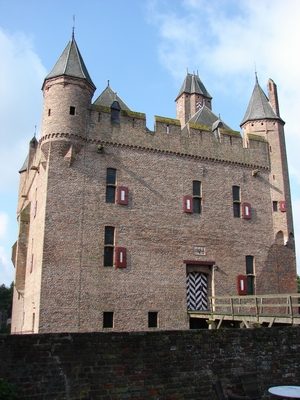
In the Betuwe region of the Netherlands, near the town of Doornenburg, stands one of the country's largest and best-preserved moated castles. Kasteel Doornenburg is built as two connected fortifications, a design that has defined the site since the medieval period and that survived a near-total wartime destruction in the twentieth century.
A castle built in two parts
A fortified residence stood on the site as early as the ninth century, but the castle grew into its present form mainly during the thirteenth to fifteenth centuries. Its distinctive layout separates the voorburcht, an outer castle that once held farm buildings, stables and staff quarters, from the hoofdburcht, the main castle proper, reached across a narrow bridge and surrounded by its own moat. Several noble families held the castle across the centuries, including the Van Doornenburg, Van Homoet, Van Rechteren van Voorst and Van der Heyden families, each leaving their mark on the buildings and grounds.
Decline and a 1930s restoration
Like many rural castles, Doornenburg fell into disrepair during the eighteenth and nineteenth centuries. Its fortunes changed in 1936, when the Stichting tot Behoud van den Doornenburg (Foundation for the Preservation of Doornenburg) acquired the property and began a careful restoration, completed in 1941.
Destruction and reconstruction
That restoration was undone within a few years. In March 1945 the castle was devastated by British bombing during the final phase of the Second World War, leaving much of the structure in ruins. Reconstruction began soon after and continued, using historical research and traditional building techniques, until the work was completed in 1968 – an almost complete rebuilding of the castle as it had stood before the war.
Architecture
The rebuilt castle preserves its medieval military logic: thick perimeter walls, corner towers and a central keep, designed to withstand siege, sit alongside chapels, halls and living quarters added as the fortress evolved into a more comfortable residence. The division between the working outer castle and the fortified inner castle remains legible in the layout today, giving visitors a clear sense of how a medieval noble household combined defence with domestic life.
Visiting today
Doornenburg Castle is open to the public, with guided tours through its furnished halls, kitchens and cellars. It has also served as a filming location, most notably for the Dutch television series Floris in the 1960s, and its grounds regularly host medieval-themed markets and re-enactments. The rebuilt castle stands today largely as it did before the war, a reconstruction close enough to the original that its two-part medieval plan and defensive architecture remain the main reasons to visit.
The estate's grounds, including a working farm and orchards in the outer castle, are managed today alongside the historic buildings, giving visitors a sense of the self-sufficient rural economy that once supported the household living within the fortified walls.