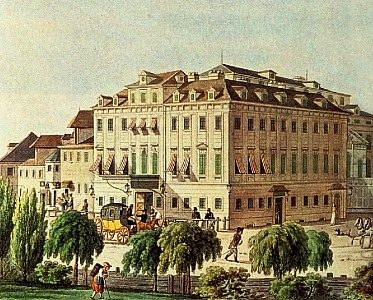
Founded by Mozart's librettist
Theater an der Wien was founded by the impresario and librettist Emanuel Schikaneder, best known for his collaboration with Mozart on 'The Magic Flute'. Built on the banks of the river Wien, since built over at this stretch, which gave the theatre its name, it was designed by the architect Franz Jäger in the Empire style and equipped with sophisticated stage technology for its time. It opened on 13 June 1801 with a prologue by Schikaneder followed by a performance of Franz Teyber's opera 'Alexander'.
Beethoven's theatre
Between 1803 and 1804 Ludwig van Beethoven lived in an apartment provided to him within the theatre, and it became the setting for several major premieres: his Second Symphony in 1803, the 'Eroica' Third Symphony in 1805, the Violin Concerto in 1806, the Fourth Symphony in 1807, and the Fifth and 'Pastoral' Sixth Symphonies in 1808. His only opera, 'Fidelio', also had its premiere here, in 1805, cementing the theatre's reputation as a proving ground for some of the most ambitious orchestral and operatic works of the early nineteenth century.
The home of Viennese operetta
Through the nineteenth century the theatre became the centre of Viennese operetta, staging works by Johann Strauss father and son, Franz Lehár and Emmerich Kálmán, including 'Die Fledermaus', 'The Merry Widow' and 'The Csárdás Princess'. After the Vienna State Opera was destroyed in the Second World War, Theater an der Wien served as its temporary home between 1945 and 1955. In the later twentieth century it hosted long-running musicals such as 'Elisabeth' and 'Mozart!', before being relaunched in 2006, on the 250th anniversary of Mozart's birth, as a dedicated opera house under the name 'Neues Opernhaus'.
The Papagenotor
The theatre's most recognisable architectural feature is the Papagenotor, or Papageno Gate, on the left side of the main facade. It is the only part of the building surviving unaltered from 1801, a monument to Schikaneder topped by a sculpture of Papageno and the Three Boys from 'The Magic Flute', and it remains a direct physical link between the present building and its founding director, surviving intact through two centuries of rebuilding, bomb damage repair and repeated changes of artistic direction inside.
Theater an der Wien today
Since its 2006 relaunch, the theatre has built a reputation for baroque and classical opera performed with period instruments and historically informed practice, alongside contemporary and rarely staged works. It serves as a key venue for the annual Wiener Festwochen performing arts festival, hosting premieres and special projects, and continues to draw leading conductors, directors and singers to a programme distinct from that of the Vienna State Opera, giving Vienna two major opera houses with complementary rather than overlapping repertoires.