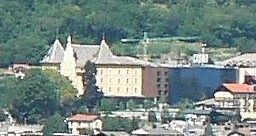
Saint-Vincent sits in the Aosta Valley, surrounded by the Alps, and its tourist history began not with gambling but with a mineral spring. The town's modern gaming venue, Casino de la Vallée, is a twentieth-century addition to a spa resort with roots in the eighteenth century.
A spa town before a casino
On 20 July 1770, the abbot Jean-Baptiste Perret, who had an interest in chemistry and mineralogy, identified a local spring with therapeutic properties. Analysis confirmed its qualities and the source, named Fons Salutis, drew growing numbers of visitors seeking treatment. Between 1827 and 1829 Queen Maria Teresa, consort of Victor Emmanuel I of Sardinia, took the waters with her daughters, staying at the Castello di Challant in Châtillon, and royal visits by figures including Queen Margherita of Savoy in 1898 helped establish Saint-Vincent's reputation, sometimes described as 'the Italian Karlsbad'. By 1872 the town already had three established hotels, and an early venue known simply as a 'Casino' existed as a music and dancing hall rather than a gaming house.
From a seasonal roulette table to a licensed casino
Gambling at Saint-Vincent began modestly. In 1921 the town's mayor, Elia Page, obtained permission from the sub-prefect of Aosta to open a roulette table for the summer season, and it operated in the Kursaal hall until the outbreak of war closed it in 1940. The modern casino followed after the Second World War: Federico Chabod, president of the Aosta Valley, issued a decree authorising a casino on 3 April 1946, the regional council approved it on 13 May 1946, and Casino de la Vallée opened on 29 March 1947 at the Grand Hotel Billia, with music provided by an orchestra under Felice Cameroni.
Architecture and setting
The casino occupies purpose-built premises attached to the Grand Hotel Billia and has been expanded and modernised repeatedly since its 1947 opening to serve an international clientele, while remaining set within the alpine landscape of the Aosta Valley, ringed by peaks including Monte Bianco, Monte Rosa, the Matterhorn and the Gran Paradiso. The complex today combines the original hotel-casino nucleus with later additions built to accommodate a much larger volume of visitors than the seasonal roulette table of the 1920s.
Saint-Vincent today
The town continues to present itself around the dual identity established in the nineteenth and twentieth centuries: a spa resort built on the reputation of the Fons Salutis spring, and a gaming and events destination built up around the Grand Hotel Billia site since 1947. The Hôtel du Lion d'Or, one of the three hotels recorded in Saint-Vincent as early as 1872, remains in operation, giving the town a direct link to its pre-casino history as a spa destination for the Piedmontese aristocracy.