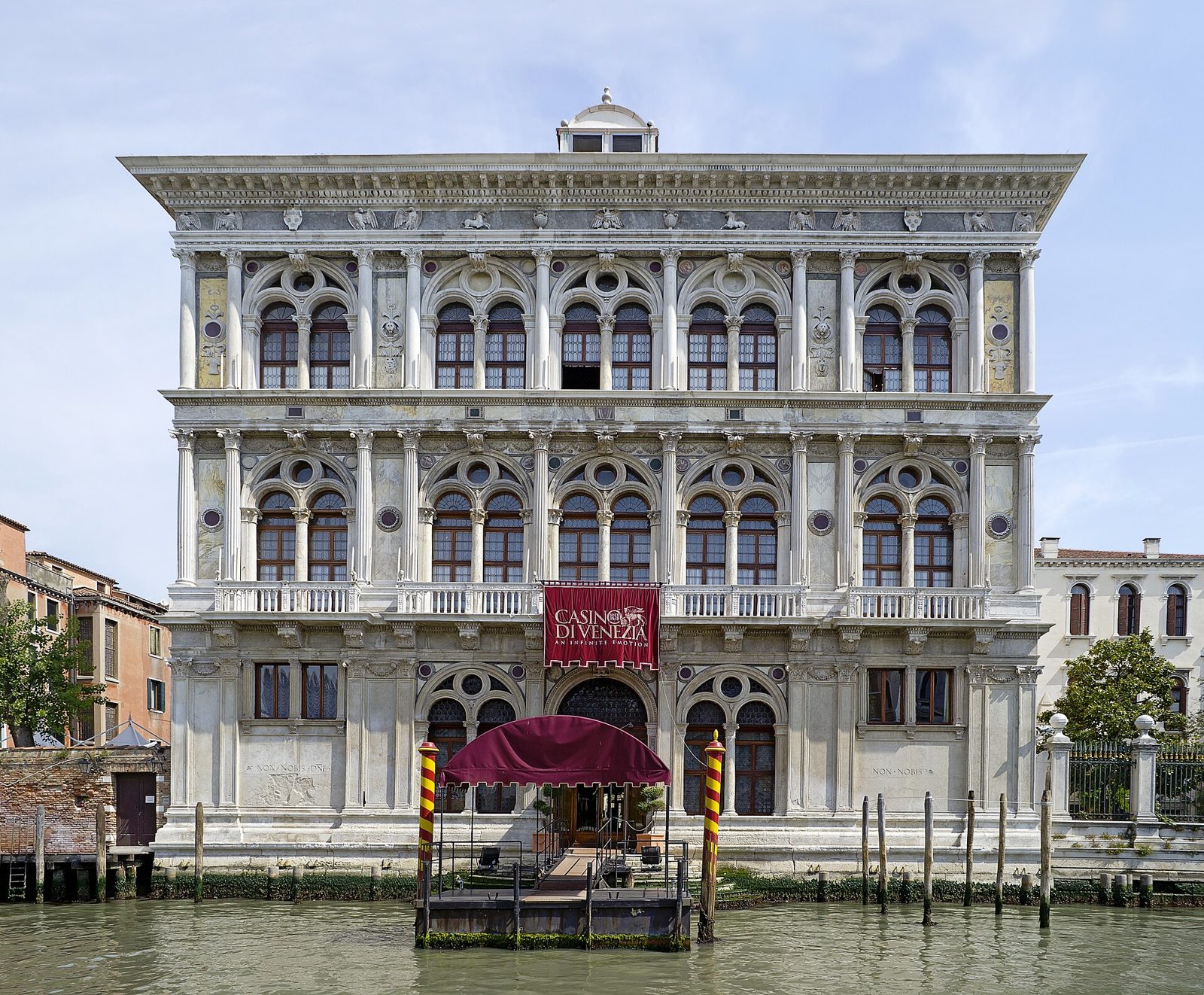
On the Grand Canal, in the Cannaregio district, Ca' Vendramin Calergi houses the winter premises of the Casinò di Venezia. The institution traces its origins to 1638, when the city's governing council authorised the opening of the Ridotto, widely regarded as the oldest regulated gambling house in the world. The palace itself is a separate and older story: a Renaissance building begun in 1481, more than a century and a half before the Ridotto existed.
The Ridotto and the modern casino
The Ridotto operated in Palazzo Dandolo, near the parish of San Moisè, during Carnival season, offering games such as biribissi and bassetta under formal dress rules that in practice limited access to the nobility and the wealthy. It closed in November 1774. The modern Casinò di Venezia dates from the twentieth century: a summer venue opened at the Lido on 1 July 1936, and the city of Venice acquired Ca' Vendramin Calergi in 1946, later establishing it as the winter premises. A third venue, Ca' Noghera, opened in 1999 as the first American-style casino in Italy.
Ca' Vendramin Calergi: a Renaissance palace
The palace was commissioned by the Loredan family and built between 1481 and 1509, probably to a design by the architect Mauro Codussi. Its facade, one of the most representative examples of Venetian Renaissance architecture, adapts Alberti's Palazzo Rucellai in Florence to a Venetian setting, rising over three storeys marked by superimposed Doric, Ionic and Corinthian half-columns, with five unevenly spaced two-light windows per floor creating the effect of a two-storey loggia. Giorgione is recorded as having painted some of the interior decoration, since lost. In 1581 the Loredan sold the palace to Eric II, Duke of Brunswick-Lüneburg; ownership later passed to the Gonzaga of Mantua and, in 1614, to Vittore Calergi, who added the palace's north wing. The Vendramin family inherited it in 1739, giving the building its present double name.
Richard Wagner's death, 1883
In 1844 Marie Caroline of Bourbon-Two Sicilies bought the palace. Richard Wagner rented rooms on the piano nobile and moved in with his wife Cosima and their children in September 1882; he died there of a heart attack on 13 February 1883, aged 69. In 1937 the financier Giuseppe Volpi, Count of Misurata, bought and restored the palace; the city of Venice acquired it in 1946. Since February 1995 part of the building has housed the Wagner Museum, curated by the Associazione Richard Wagner di Venezia, which holds one of the largest private Wagner collections outside Bayreuth and organises the annual Giornate Wagneriane.
The interiors
Inside, a long ground-floor portego leads to the monumental staircase. The T-shaped Salone on the piano nobile retains sixteenth-century work by Palma il Giovane and later seventeenth-century additions, including the Sala del Camino and the Sala dei Cuori d'Oro. These rooms, along with the rest of the winter premises, now form part of the working Casinò di Venezia, while the Sale Wagner remain open to visitors by appointment through the Wagner association.