A Monastery for the Crosier Friars
The Kruisherenhotel occupies a former monastery of the Order of the Holy Cross, known in Dutch as the Kruisheren or Crosiers, in the centre of Maastricht. The community's presence on the site dates to 1437 and 1438, when Gillis van Elderen donated five houses at the Kommel to the order and Jan van Heinsberg authorised the construction of convent buildings, including a Gothic church that came to dominate the surrounding streets. For more than three centuries the monastery functioned as a working religious house, its friars devoted to prayer, study and service to the local community, part of the dense network of churches and religious houses that once filled Maastricht's old town.
Secularisation and Decline
The monastery's original purpose ended at the close of 1796, when the French administration then governing the region suppressed the Kruisherenklooster along with many other religious houses. The ten friars still resident were required to leave within a year, and the building passed out of religious use, later serving among other things as a military storage facility. Long periods of disuse and adaptation left it altered and in decline compared with its original medieval form, its grand church interior put to purposes far removed from worship.
From Monastery to Hotel
A new chapter began in 2000, when the municipality of Maastricht sold the complex to the hotelier Camille Oostwegel. Between 2003 and 2005 the building was restored and converted into a luxury hotel by the architecture firm SATIJNplus, with interior design by Henk Vos, whose work on the project was recognised with a European Design Award in 2005. The hotel opened officially on 1 September 2005.
Gothic Vaults and Contemporary Design
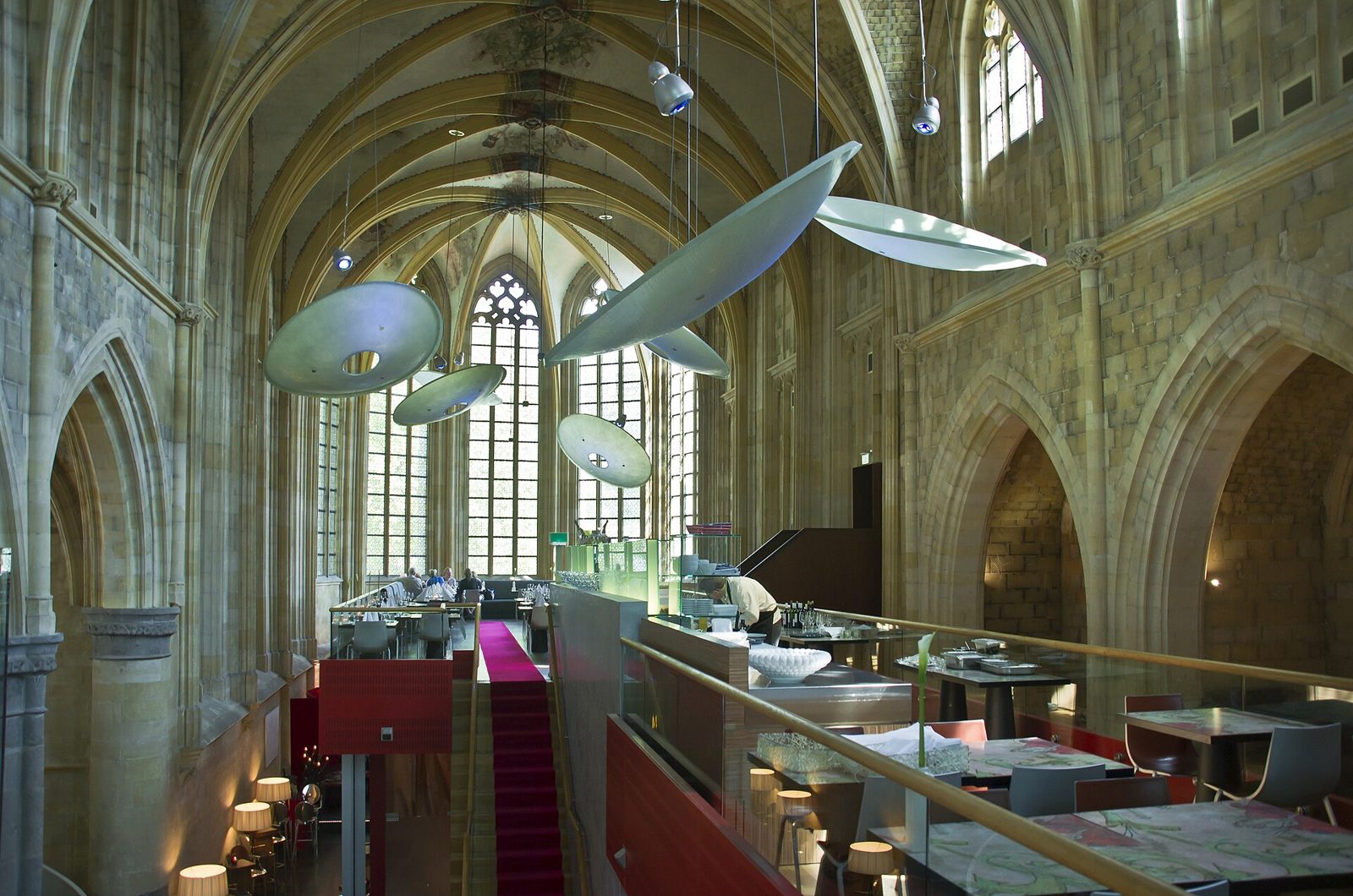
The conversion kept the monastery's Gothic structure largely intact rather than concealing it: the tall vaulted nave, stone piers and tracery of the former church remain the building's dominant feature. Contemporary elements, in glass, steel and pale wood, were inserted into this shell as discrete, self-contained additions rather than alterations to the historic fabric itself, an approach that keeps the two languages, medieval stone and modern design, visually distinct from each other rather than blended into one.
The Hotel Today
Guest rooms now occupy spaces that once formed part of the friars' living quarters and other monastery buildings, while the former nave serves as the hotel's main public room, housing its restaurant and bar beneath the original Gothic vaulting. Breakfast is served in what was once the church's choir, and the complex also includes a library and a wine cellar set into the old undercroft. The Kruisherenhotel presents itself less as a converted building than as two distinct structures occupying the same space, the 15th-century monastery and the 21st-century hotel inserted within it.