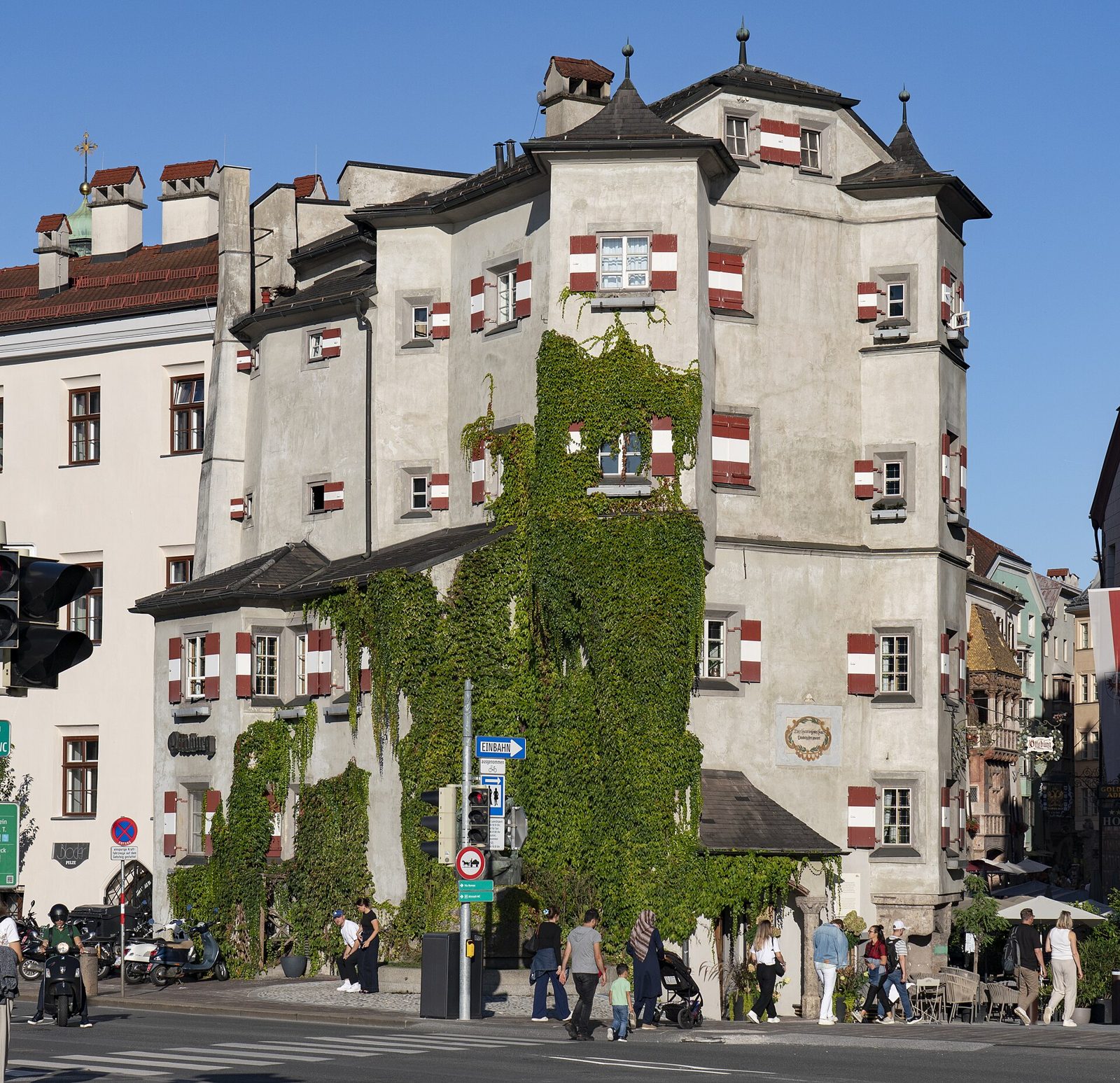
At the entrance to Innsbruck's old town, where Herzog-Friedrich-Straße meets the banks of the River Inn, a polygonal late-Gothic tower known as the Ottoburg has stood for more than five hundred years, its name carrying a piece of local legend that later research has shown to be historically mistaken.
A tower first recorded in 1476
The Ottoburg is first documented in 1476, and was rebuilt in 1494 and 1495 before being further extended in 1542. Architecturally it is a late-Gothic residential tower, four to five storeys high, polygonal in plan and built into a corner of Innsbruck's former city wall, distinguished by a corbelled bracket supporting its upper floors. Its original two upper storeys were joined by a third, added in 1775 along with a gabled roof, and its facade today carries ninety red-white-red painted wooden shutters, a striking and recognisable feature of the building.
From imperial gift to bourgeois ownership
In 1497 Emperor Maximilian I granted the tower to Prince Rudolf of Anhalt-Bernburg. After Rudolf's death in 1510, ownership passed out of noble hands, and the building continued under a succession of bourgeois owners in the centuries that followed.
A name rooted in mistaken etymology
The building's current name has a more complicated history than it suggests. Between 1565 and 1568 records refer to the building as "Eepurg" or "öd Burg" – meaning, roughly, "empty castle" – reflecting a period when it stood unused. By 1628 this had evolved into "Öttburg", and in the late eighteenth century this form led to a popular association with Duke Otto II of Andechs, at the time mistakenly believed to have founded Innsbruck. The name Ottoburg that resulted is therefore a product of linguistic drift and a historical misunderstanding rather than a genuine link to the Andechs dynasty, even though it is still sometimes described, inaccurately, as a relic of a thirteenth-century Andechs stronghold.
A restaurant since 1913
The Ottoburg was converted for use as a restaurant in 1913, a function it has kept ever since. Its position at the edge of Innsbruck's old town, directly above the River Inn, has made it one of the more recognisable buildings along the riverfront, its shuttered facade and corner tower forming part of the classic view of the old town from across the water.
Visiting today
The Ottoburg continues to operate as a restaurant today, occupying rooms within a structure whose late-Gothic core, dating substantially from the 1494–95 rebuilding, survives beneath the later additions of 1542 and 1775. Its long history as a private residence, granted and passed among noble and bourgeois owners over four centuries, gives the building a depth of history distinct from the folk legend attached to its name.
Innsbruck's old town, where the Ottoburg stands, retains much of its late-medieval street plan, and the tower's position at the point where the historic centre meets the river bank has kept it a fixed reference point in views of the city for as long as the building has stood.