Nearly a century in the making
Discussion of a grand opera house for Catania began in the early nineteenth century, as the city's middle classes sought a theatre able to compete with those of Europe's larger cities. An initial design by the architect Salvatore Zahra Buda, known as the 'Teatro Nuovaluce', followed the foundation stone laid in 1812, but funding problems repeatedly delayed the project. In 1870, the architect Carlo Sada was engaged to find a suitable site, and the city eventually settled on building a dedicated opera house rather than a multi-purpose venue, a decision that reflected Catania's ambition to match the opera houses of Palermo and Naples rather than settle for a general-purpose civic hall. Once building started, construction moved comparatively quickly, and the theatre opened on 31 May 1890 with a performance of Bellini's Norma, named in tribute to the Catania-born composer.
A late-nineteenth-century eclectic design
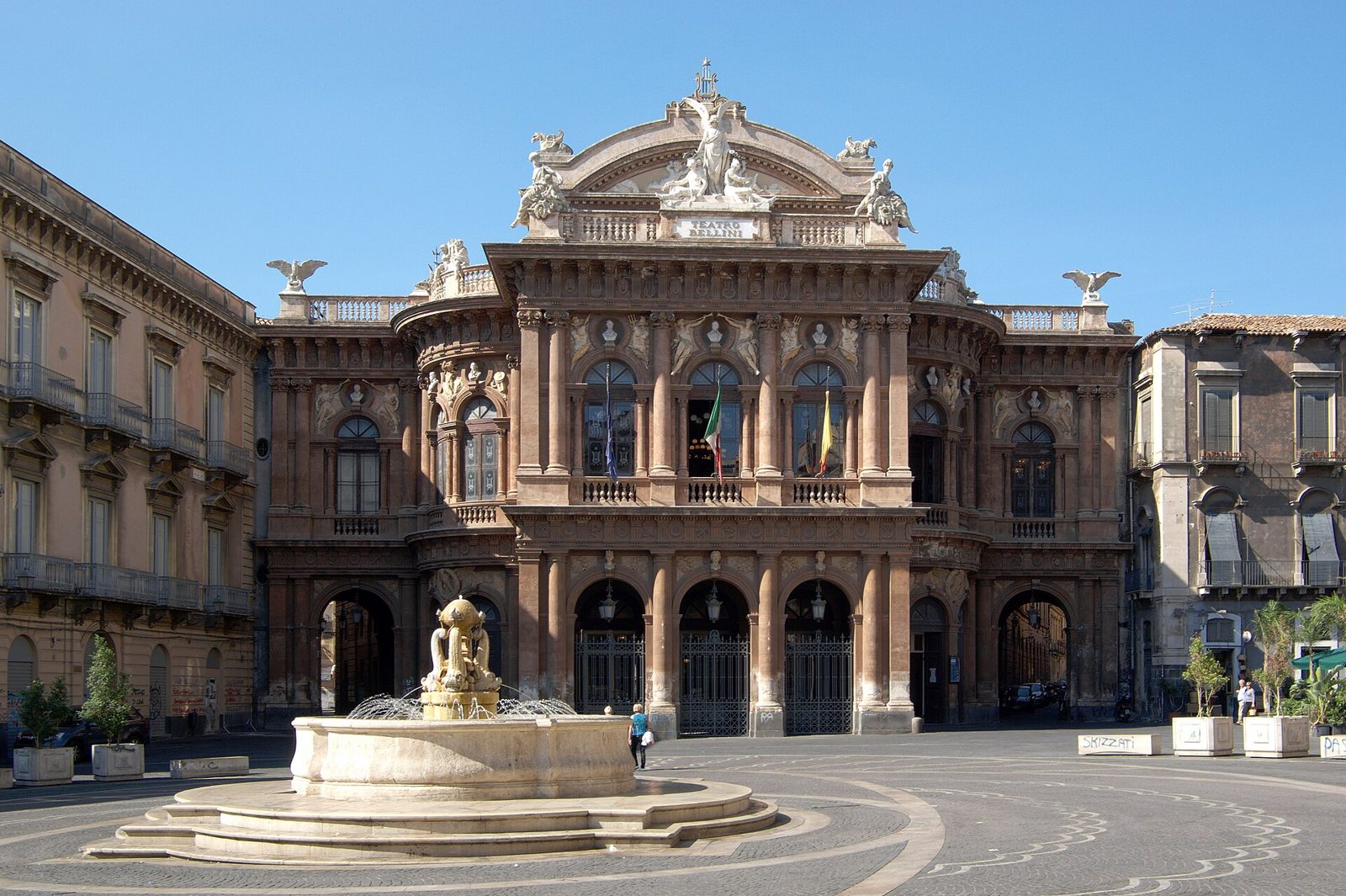
The theatre's design draws on French eclecticism of the period, in particular the model of the Paris Opera. Its facade, inspired by the late Renaissance, presents visitors with a three-arched portico beneath allegorical statues, crowned by a sculpture of Bellini overlooking the entrance, a facade meant to announce the theatre's civic and artistic ambitions before a visitor ever steps inside. Inside, an ornate marble foyer with a statue of the composer leads into the horseshoe-shaped auditorium typical of Italian opera houses, its four tiers of boxes finished in red velvet and gilding, seating around 1,200 people. The horseshoe plan, standard in Italian opera houses of the period, was chosen for its acoustic properties as much as for the sightlines it gave every tier of boxes onto the stage.
The ceiling fresco
The auditorium's ceiling carries a large fresco by Ernesto Bellandi, 'Il Trionfo di Bellini', depicting scenes drawn from several of the composer's best-known operas alongside mythological and allegorical figures, and it remains the theatre's most striking single decorative feature, drawing the eye upward from the boxes and stalls to a single unifying image of the composer the theatre is named for.
The Bellini today
The theatre continues to stage opera, symphonic concerts and ballet, and has hosted leading singers and conductors over more than a century of programming, including performances by Maria Callas in Norma in the early 1950s to mark the 150th anniversary of Bellini's birth. Its repertoire still gives particular weight to Bellini's own operas, maintaining the link between the composer and the theatre that carries his name, while its programming also extends into the wider Italian and international operatic tradition. The theatre stands close to the house where Bellini was born, giving Catania a compact area in which visitors can trace the composer's connection to his home city from birthplace to the stage built in his memory.