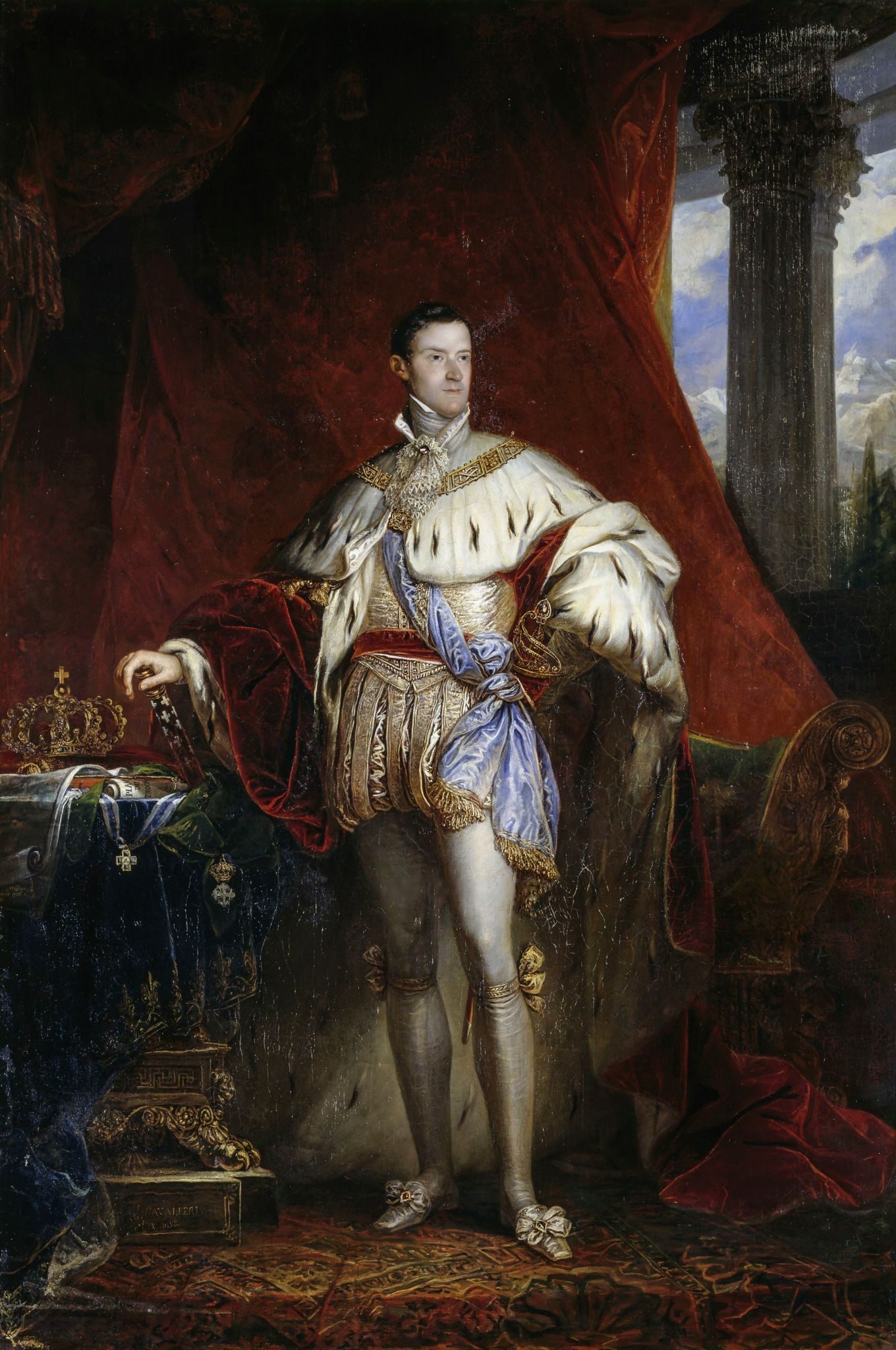
A cadet branch, an uncertain succession
Charles Albert of Savoy-Carignano was born on 2 October 1798 at the Palazzo Carignano in Turin, into the cadet Carignano branch of the House of Savoy. With the main line of succession still intact, his own prospects of the throne of the Kingdom of Sardinia seemed remote for years. Much of his childhood and youth was spent in France during the Napoleonic period, exposing him to liberal ideas that sat uneasily alongside the conservative outlook of the Savoy court, a tension that shaped his later reputation for indecision.
The 'Re Tentenna'
That wavering surfaced early. In 1821, amid uprisings demanding a constitution from King Victor Emmanuel I, Charles Albert initially appeared to side with the conspirators, then reversed his position on 7 March and revealed the plot to the authorities. Made regent, he reluctantly granted the Spanish Constitution on 13 March, before it was withdrawn soon after. The episode earned him the nickname 'Re Tentenna', the hesitant king. In 1823 he took part in the legitimist military expedition to Spain to restore King Ferdinand VII, distinguishing himself at the Battle of Trocadero, where he led troops across a canal under fire while carrying the flag, service that won him French military honours and, for a time, rehabilitated him with conservative circles.
A conservative reign, then 1848
Charles Albert became king on 27 April 1831, on the death of his childless uncle Charles Felix, and his early reign was markedly conservative, supporting legitimist causes elsewhere in Europe and resisting liberal and national demands within his own territories. The upheavals of 1848 changed his course. On 4 March 1848 he granted the Statuto Albertino, a constitutional charter that, while preserving extensive royal powers, introduced fundamental liberal principles and remained the basic law of the Kingdom of Sardinia and later the Kingdom of Italy until 1947.
War and abdication
Riding the wave of enthusiasm that followed Milan's 'Five Days' uprising, Charles Albert led Piedmontese forces into the First Italian War of Independence against Austria, aiming to free Lombardy-Venetia. Abandoned by allies including Pope Pius IX and Ferdinand II of the Two Sicilies, and facing superior Austrian forces, his troops were defeated at Custoza in 1848 and decisively at Novara on 23 March 1849. He abdicated that same day in favour of his son, Victor Emmanuel II, and died in exile at Porto, Portugal, on 28 July 1849.
Legacy
The poet Giosuè Carducci called him an 'Italian Hamlet' for his conflicted, hesitant temperament. Despite the military defeat that ended his reign, Charles Albert's decision to grant the Statuto Albertino and his attempt to challenge the settlement imposed by the Congress of Vienna are remembered as decisive steps toward Italian unification, a process his son would carry to completion.