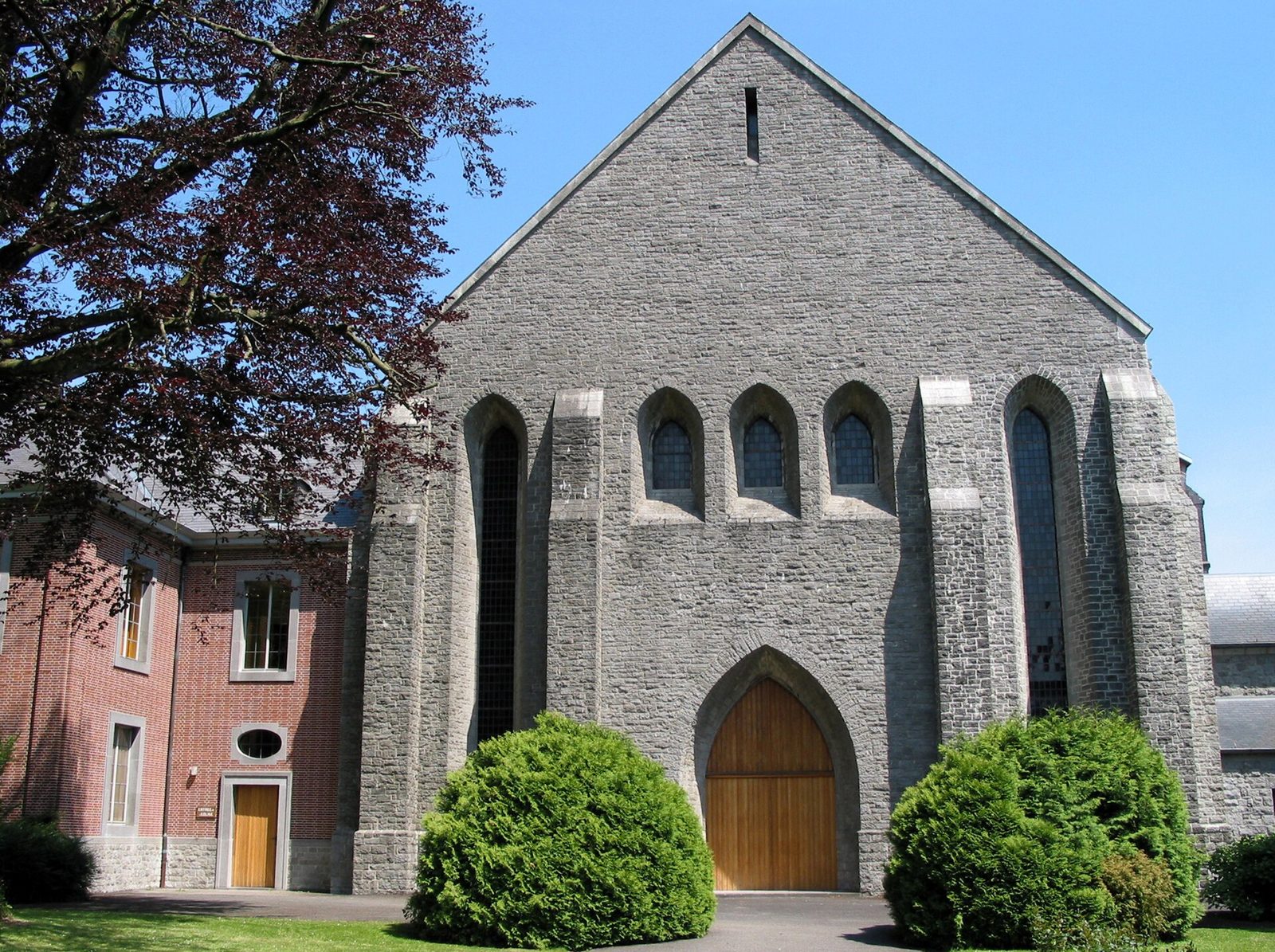
A Monastery on the Ardennes Plateau
Notre-Dame de Scourmont stands on a plateau in the Belgian Ardennes, a short distance from the town of Chimay, in Hainaut province. The community was founded on 25 July 1850, when a small group of Trappist monks from the abbey of Westvleteren settled on the plateau and established a priory on what was then largely barren land. The new foundation grew steadily, and on 24 February 1871 Pope Pius IX raised it to the status of a full abbey, an elevation formally marked by an inauguration ceremony that July.
Prayer and Manual Work
As a Trappist community, Scourmont follows the Cistercian tradition of combining prayer, reading and manual labour as the three basic elements of monastic life. In practice, this meant the monks spent much of their early history physically transforming the plateau itself, clearing and cultivating land that had offered little agricultural value before their arrival, and building up a farm alongside the monastery buildings.
From Farm to Brewery
Out of that agricultural work grew the abbey's best-known activity today: the production of beer and cheese under the Chimay name, a business built directly on the farm the monks themselves had established generations earlier. The monks established both a cheese dairy and a brewery as part of the abbey's economic base, and Scourmont remains one of the small number of monasteries worldwide still producing an officially recognised Trappist beer, a designation that requires the beer to be brewed within the monastery walls under the monks' own supervision. Income from these products supports the community directly, allowing the monks to maintain their life of prayer without depending on outside funding.
Hospitality and Daughter Foundations
Alongside its production, Scourmont maintains a guesthouse that welcomes visitors seeking to share, for a few days, the monks' silence and rhythm of prayer. The abbey's growth over more than a century and a half also allowed it to found daughter communities elsewhere, including Caldey Abbey in Wales and a monastery in what was then the Belgian Congo, extending the Scourmont tradition well beyond its original site in Hainaut.
Scourmont Today
The abbey continues to function as an active Trappist community rather than a historical monument alone, with a resident group of monks maintaining the same daily rhythm the community has followed since 1850. Its architecture, built for the practical needs of monastic life rather than for display, reflects the same restraint that shapes the Cistercian tradition generally. The Chimay brand has given Scourmont a level of international recognition unusual for a monastery of its size, reaching markets far beyond the Ardennes, but the brewery and dairy remain, for the community itself, a means of supporting a life still centred on prayer and manual work rather than an end in themselves.