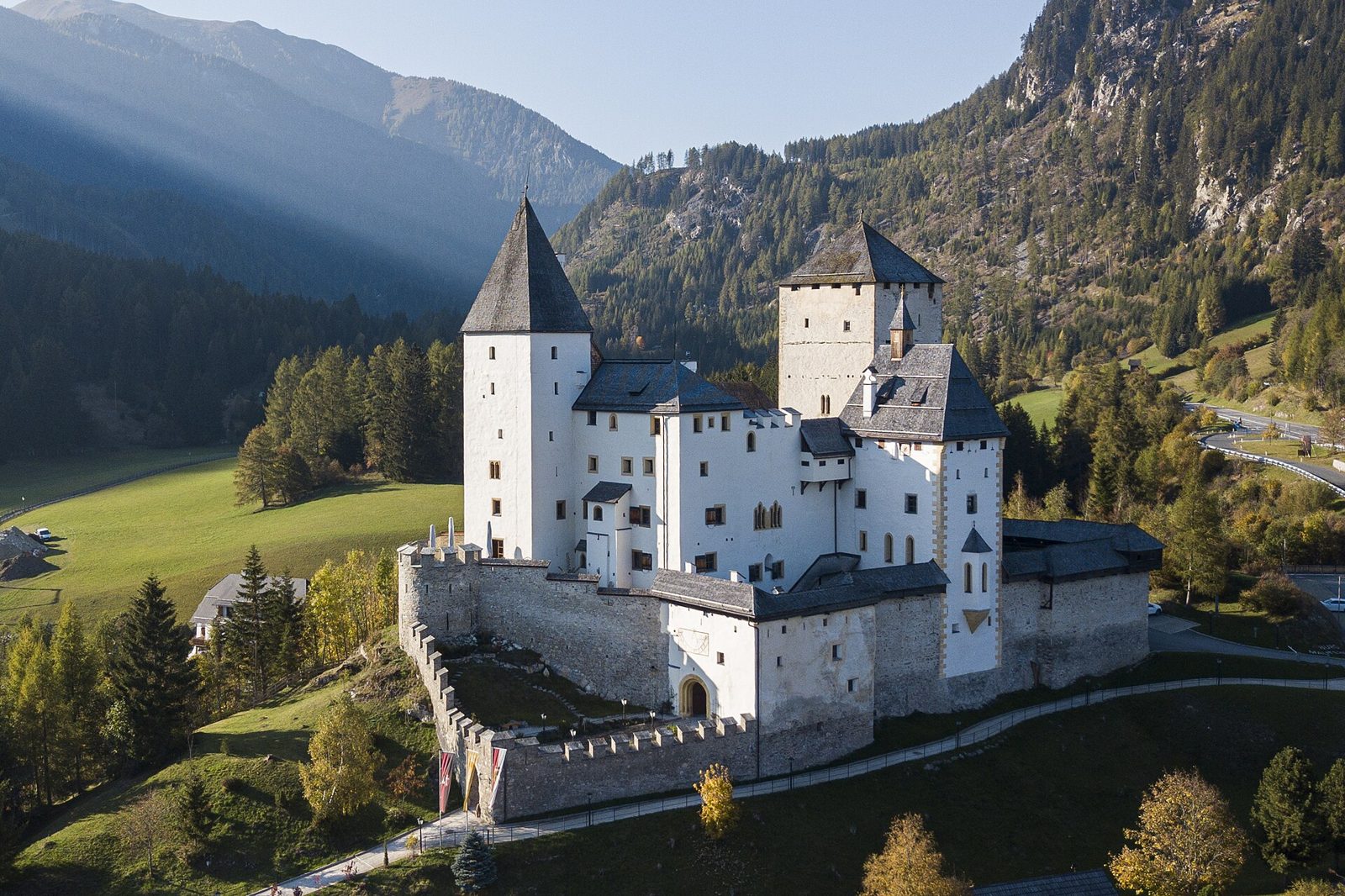
A stronghold of the Archbishops of Salzburg
Mauterndorf Castle stands on a rocky hill above the village of the same name in the Lungau district of Salzburg, Austria, controlling the approach to the Radstädter Tauern pass. Its position made it an important checkpoint on the trade routes crossing the Alps, particularly for the transport of salt, iron and gold. The castle is first documented in 1253, when its central keep was built, and it belonged from the outset to the Archbishopric of Salzburg, which administered the surrounding Lungau region through officials known as Pfleger, based at the castle. The Pfleger exercised civil, judicial and military authority in the archbishop's name, making the castle as much an administrative headquarters as a fortress.
Expansion under the archbishops
The castle was enlarged over the following centuries, with major building work in the fifteenth century under Archbishops Burkhard von Weißpriach and Leonhard von Keutschach. Keutschach in particular transformed the fortress into a grander residence, adding the tower that still bears his name, the Keutschacher Turm, giving Mauterndorf both a defensive and a representative role reflecting the wealth of the Salzburg archbishops. The castle's irregular plan, shaped by the gneiss outcrop it sits on, combines these later Gothic and Renaissance additions with earlier, plainer sections of wall.
Decline and private ownership
The castle's military and administrative importance declined after the sixteenth century, and by the nineteenth century it had fallen into a poor state of repair. Following the Napoleonic Wars, it passed into Austrian state possession in 1806, though this did little to halt its deterioration. In 1894 the Prussian army physician Hermann von Epenstein bought and restored the decaying building, work that earned him a minor title of nobility from Emperor Franz Joseph I in 1908. After Epenstein's death in 1934, the castle eventually passed to his godson, the Nazi leader Hermann Göring. Ownership reverted to the Austrian state after the Second World War, following a period of legal dispute, with the state of Salzburg formally taking control of the castle in 1968.
A regional museum today
Mauterndorf Castle is now managed as a cultural site. A castle museum opened in 2003, followed by the dedicated Lungau regional museum in May 2007, together presenting exhibits on the castle's own history and the life of the Pfleger administrators who once ran it. Its rooms display archaeological finds, weapons, tools and period furnishings, and the Keutschacher Turm remains open to visitors, with views over the Lungau valley from its upper floors. The castle also hosts medieval markets, historical re-enactments and falconry displays through the year, has served as a filming location, including for a 2008 television adaptation of Sleeping Beauty, and appeared on Austria's 50-schilling banknote in the 1956 series, a reminder of its standing among the country's best-preserved medieval castles.