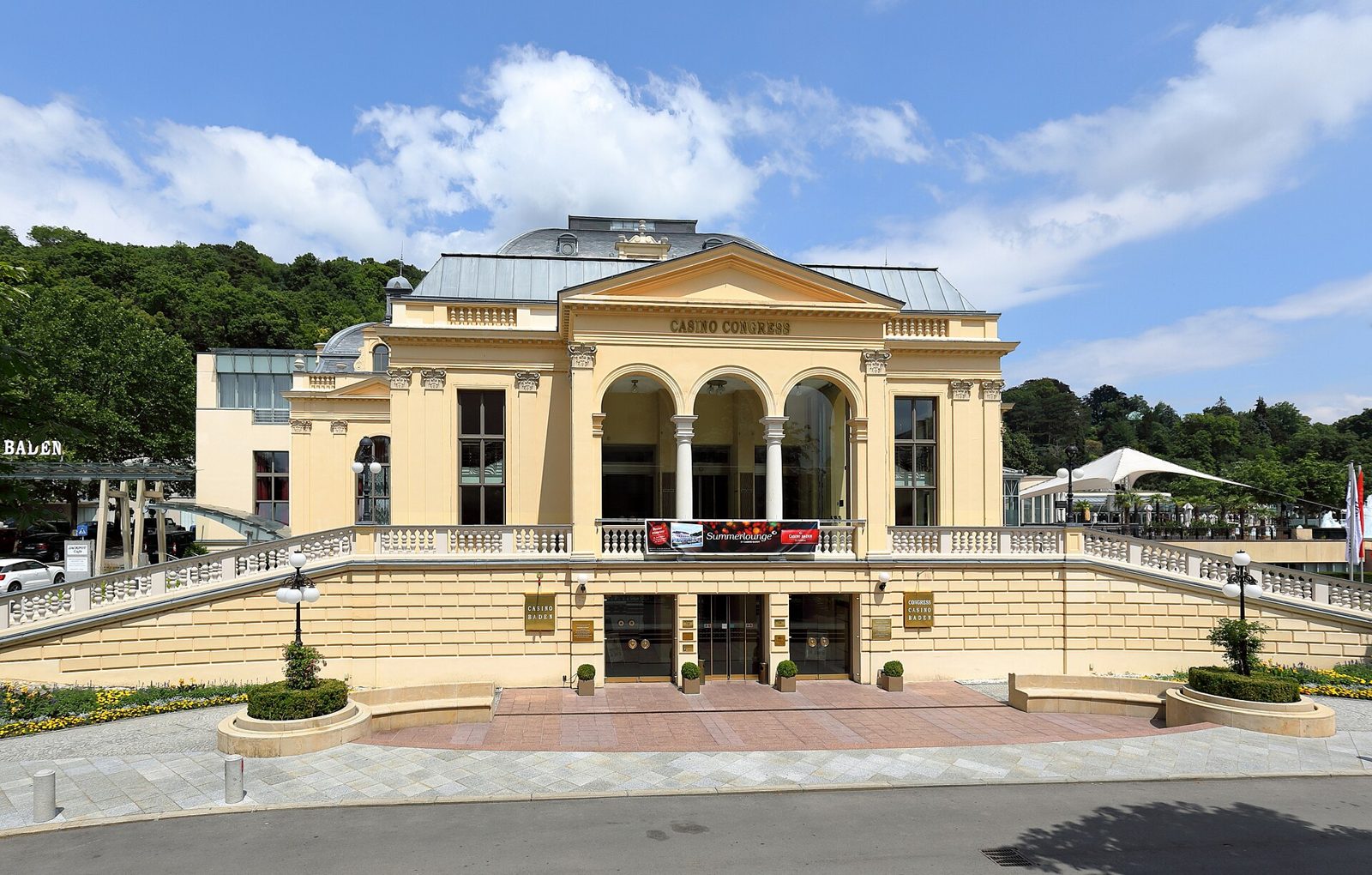
Baden bei Wien lies about thirty kilometres south of Vienna, in Lower Austria. The town has been known since Roman times for its thermal springs, and its surrounding vineyards and Kurpark helped make it a fashionable spa destination for the Viennese in the nineteenth century. The building that now houses Casino Baden was built as a spa hall, the Kurhaus, and its history runs from imperial-era spa culture to a large late-twentieth-century renovation.
From spa house to casino
The Kurhaus was built between 1884 and 1886 to a design by the architects Eugen Fassbender and Maximilian Katscher, replacing the older Theresienbad in the spa park. It was conceived as a modern centre for cures and social life, in the fin-de-siècle style typical of Austrian spa towns of the period.
A casino was later established inside the Kurhaus. Gaming operations were interrupted by the Second World War. Baden itself served as the headquarters of the Soviet occupation forces in Austria from 1945 until the country regained full sovereignty in 1955, and the town's peacetime activities, including its casino, were affected by this period. The most significant change to the building came between 1992 and 1995, when a large renovation and expansion project reopened it in 1995 as one of the largest casinos in Europe, integrated with a congress and events centre.
Architecture of the Kurhaus
The Kurhaus is built in the eclectic historicist style common to grand Austrian spa architecture of the 1880s, combining Neo-Renaissance elements with the decorative vocabulary of the period. Its principal rooms were designed to impress visitors taking the cure, with tall windows, formal proportions and a layout suited to both quiet convalescence and evening social life. The building sits within Baden's Kurpark, the same landscaped spa garden that has anchored the town's identity since the nineteenth century.
Visiting today
The Kurhaus today functions as a combined casino and events venue, and its halls are used for concerts, readings and other cultural programming alongside the gaming rooms. The building regularly hosts the Ave Verum international choir competition, one of a number of cultural events that make use of its historic spaces. For visitors interested primarily in the architecture and history of the site, the Kurpark and the surrounding spa quarter, with its nineteenth-century villas and the town's opera house, form part of the same historical fabric that shaped the building's original purpose.
Baden's identity as a spa town predates the casino by more than a century, and the Kurhaus remains one of the clearest surviving expressions of that history: a purpose-built spa hall of the 1880s, adapted at the end of the twentieth century to a new use while keeping its historicist shell and its place within the Kurpark.