From the Curia to the Cardinalate
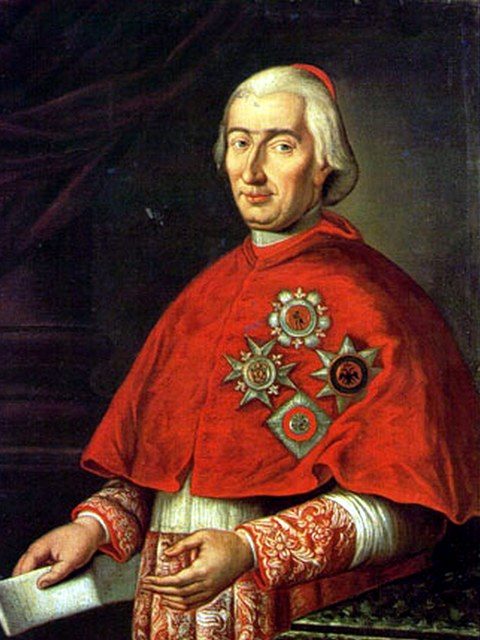
Fabrizio Ruffo was born on 16 September 1744 in San Lucido, in Calabria, into an old noble family, and died in Naples on 13 December 1827. Educated at the Collegio Clementino and at La Sapienza in Rome, he earned a doctorate in canon and civil law in 1767 and entered papal service, becoming a papal chamberlain in 1764. He rose through the Curia's administration, serving as treasurer general of the Apostolic Camera from 1785 to 1794 under Pope Pius VI, a position that put him at the centre of the Papal States' finances. His elevation to cardinal was announced in 1791 and formally published on 21 February 1794, with the title of Sant'Angelo in Pescheria, even though he had not yet been ordained a priest, a reflection of his standing at court rather than his clerical seniority.
Raising an Army in Calabria
Ruffo's best-known role began in 1798, when French troops invaded the Kingdom of Naples and forced King Ferdinand IV to flee to Sicily. In Naples, the Parthenopean Republic was proclaimed in January 1799 with the backing of local intellectuals and aristocrats. From Palermo, Ruffo proposed to the king a plan to return to his native Calabria and raise a popular force against the French and the new republic. Ferdinand IV agreed, naming him vicar-general with broad authority.
Landing near Scilla in February 1799, Ruffo assembled what became known as the Christian and Royal Army, drawing together peasants, veterans, artisans and clergy under the banner of loyalty to the Bourbon crown and the Church. The force grew to around 25,000 volunteers and advanced through Calabria and Basilicata, capturing towns and strongholds as it went, in a movement that became known as Sanfedismo.
The Fall of Naples and Nelson's Intervention
By mid-June 1799 the army had reached Naples, and the royalist reconquest of the city was effectively complete by 15 June. Ruffo negotiated a capitulation with the besieged republicans, guaranteeing their safety and the option of exile. That agreement was overturned soon afterwards by the British admiral Horatio Nelson, who arrived off Naples on 24 June 1799, rejected Ruffo's terms as dishonourable, and prevented them from being carried out. In the reprisals that followed, 124 people were executed, and Ruffo's authority over the settlement he had negotiated was effectively set aside.
Later Years and Legacy
Ruffo continued to hold political office after 1799 but was gradually sidelined by a Bourbon court wary of both his early leniency towards the republicans and his popularity in the south. He died in Naples in 1827. His campaign remains a disputed episode in southern Italian history, read by some as the defence of a legitimate monarchy against foreign invasion and by others as the crushing of the Enlightenment-influenced republic that had briefly taken hold in Naples.