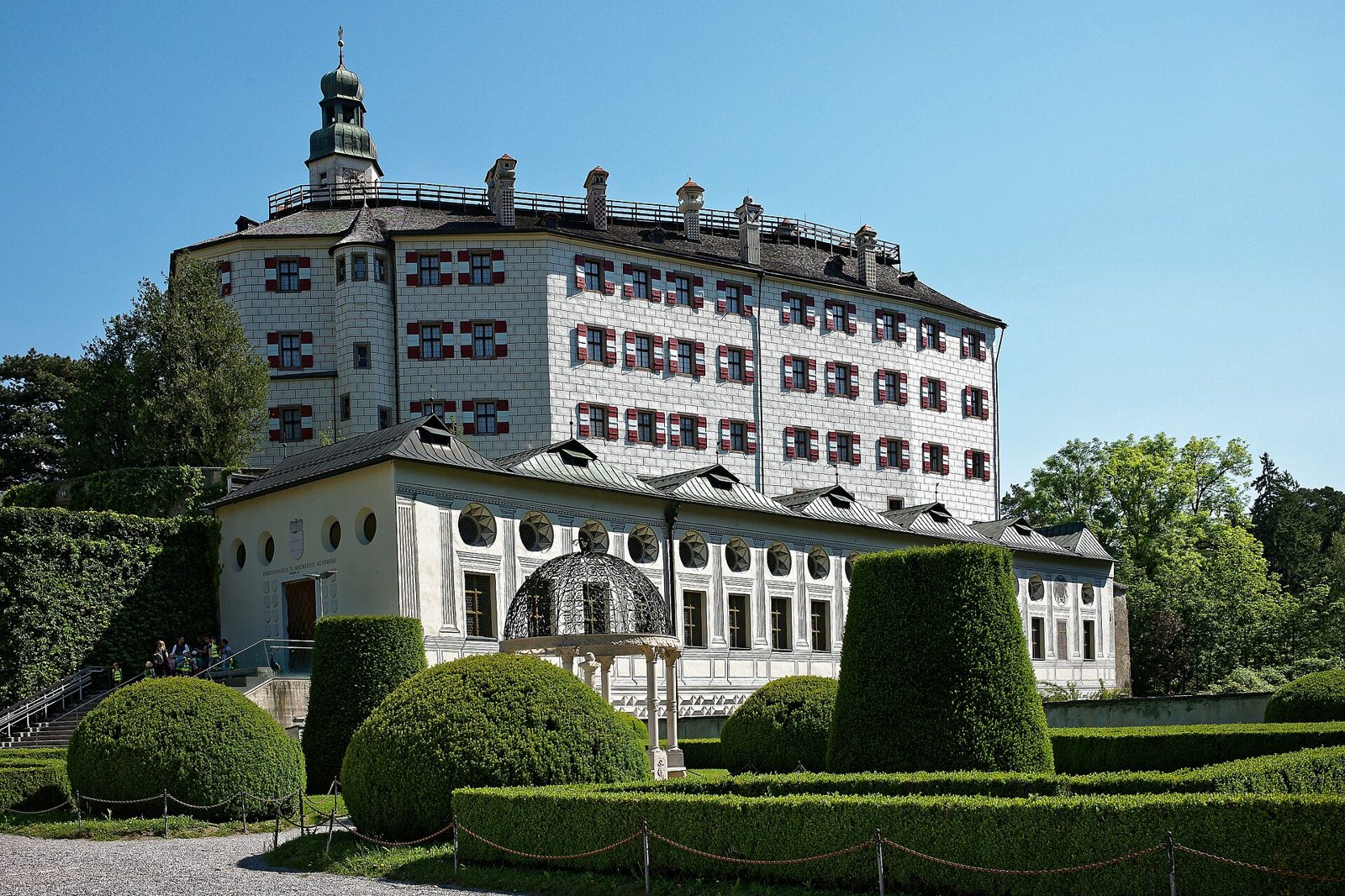
From medieval fortification to Renaissance seat
Ambras Castle stands above Innsbruck, in Tyrol, on the site of a fortification recorded under the name 'Amras' from the tenth century, when the site was held by the Counts of Andechs; that early stronghold was destroyed in 1133. The castle later passed to the Dukes of Carinthia and then to the Habsburgs, part of the broader consolidation of Tyrolean territory under Habsburg control in the later medieval period. Its decisive transformation began when Archduke Ferdinand II of Austria, son of Emperor Ferdinand I, became regent of Tyrol in 1564 and chose Ambras as his main residence, rebuilding and extending it between 1564 and 1583.
A prince's Kunstkammer
Ferdinand II was a keen collector, and Ambras was built as much to display his holdings as to house him. His Kunst- und Wunderkammer, or chamber of art and wonders, ranks among the oldest and best-preserved collections of its kind in Europe, encompassing art, armour, scientific instruments and natural curiosities in a single purpose-built display. It stands among the earliest collections displayed in what is recognisable as a museum in the modern sense, rather than a private cabinet. After Ferdinand's death much of the finest material was moved to Vienna in the nineteenth century, on the orders of Emperor Francis I, forming the nucleus of what became the Kunsthistorisches Museum; Ambras itself remained a protected monument and has since had much of its original collection returned, restoring something of the density of objects that once filled its rooms under Ferdinand.
Lower and Upper Castle
The complex divides into the Lower Castle (Unterschloss), the older, originally fortified nucleus, and the Upper Castle (Hochschloss), Ferdinand's private residence with his wife, Philippine Welser, from 1567 to 1595. The Lower Castle holds the armoury and the Spanish Hall (Spanischer Saal), a Renaissance hall roughly 43 metres long, built between 1569 and 1572, with an intarsia-panelled wooden ceiling and 27 full-length portraits of the princely rulers of Tyrol along its walls. The Upper Castle houses the Chapel of St Nicholas, with its medieval frescoes, and the Habsburg Portrait Gallery, a sequence of rooms that trace the dynasty's members across several centuries through portraiture rather than text.
Ambras Castle today
Since 1950 the castle has been administered by the Kunsthistorisches Museum Wien, which carried out extensive restoration through the 1970s and 1980s. Visitors can see the Kunst- und Wunderkammer largely as Ferdinand assembled it, along with the armoury's collection of tournament and parade armour, the Spanish Hall, still used for concerts, and the Habsburg portrait collection, set within grounds that offer views over the Inn valley and the surrounding mountains, a setting that has changed relatively little since Ferdinand first chose the site for its combination of proximity to Innsbruck and rural seclusion.