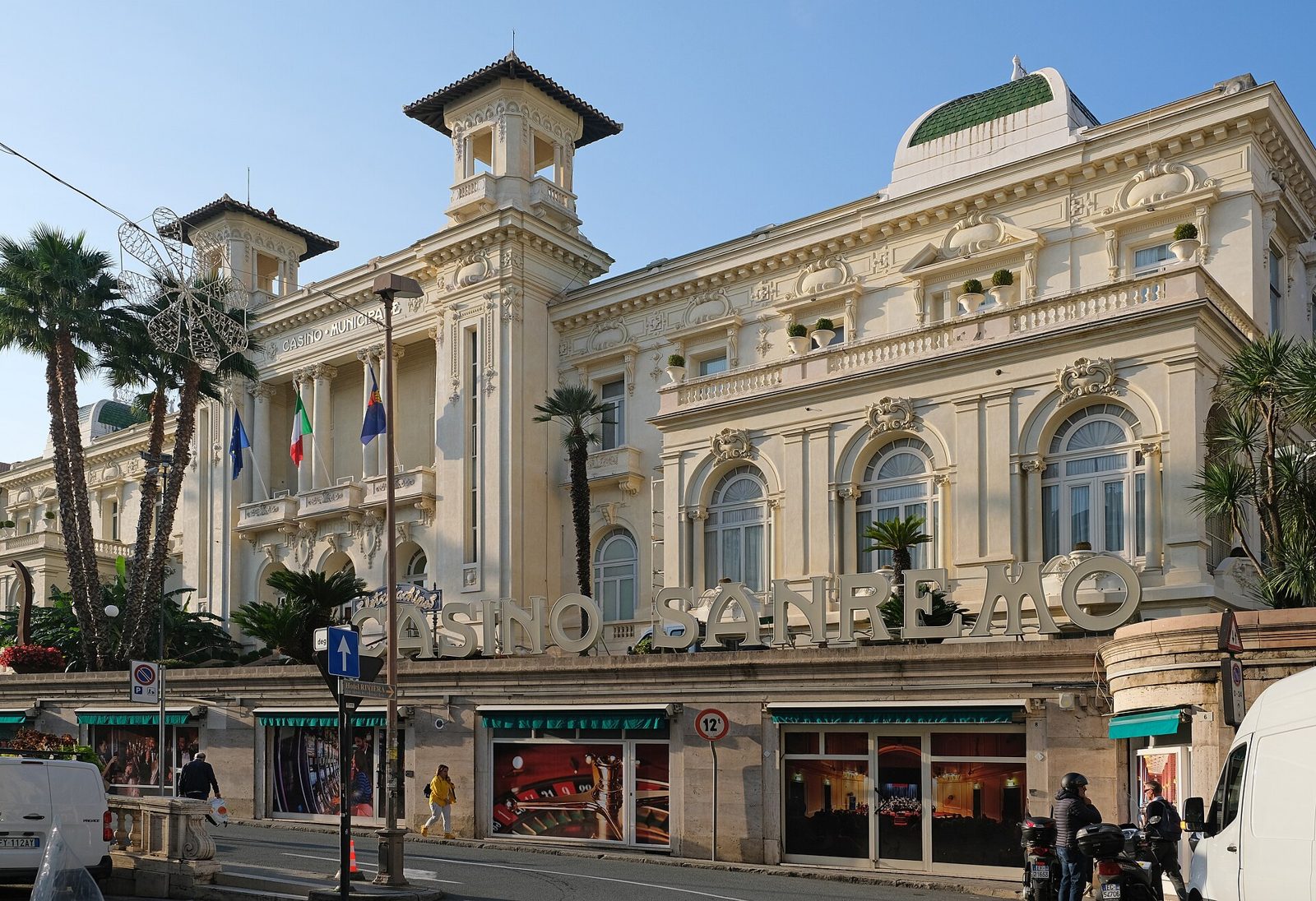
From Kurhaus to Casino
The building that now houses the Casino di Sanremo, officially the Casinò Municipale di Sanremo, opened on 14 January 1905 under the name Kurhaus, a German term for a spa and leisure hall. It was commissioned to add to the resort offer of Sanremo, already a fashionable destination for European visitors, and designed by the French architect Eugène Ferret. In its early years the Kurhaus functioned as a concert and entertainment hall, staging theatre, ballet and dance evenings; gambling took place there but without a formal licence.
That changed with a Royal Decree of 22 December 1927, which granted the building an official gaming licence. The casino held its inaugural gala on 21 January 1928, joining Venice, Campione d'Italia and Saint-Vincent as one of only four licensed casinos in Italy, a status the country still restricts to a small number of towns.
The Sanremo Music Festival
The casino's best-known chapter began on 29 January 1951, when its Salone delle Feste hosted the first edition of the Festival della Canzone Italiana, the song contest that grew into the Sanremo Music Festival. The event was staged at the casino every year until 1976, before moving to the Teatro Ariston in 1977. The building's association with the festival's founding remains a fixed part of its identity, even though the event itself has long since moved elsewhere.
A Liberty-Style Building
Ferret's design is a landmark example of the Liberty style, the Italian variant of Art Nouveau, applied to both the exterior and the interior. The main façade combines curving lines, floral relief work, allegorical sculpture and wrought iron with stained glass, while corner turrets, domes and ornamented balconies give the building a sense of scale in keeping with early twentieth-century resort architecture.
Inside, the Salone delle Feste is the most elaborate space, finished with stucco work, frescoes, marble and crystal chandeliers befitting a hall built for concerts and society events. The other reception rooms and dining areas follow the same decorative language, with period-appropriate furnishings and lighting designed to set off the plasterwork and marble.
The Building Today
The casino continues to operate from the same 1905 building, with the Salone delle Feste still used for concerts, theatre, cabaret and exhibitions alongside its original function. The restaurants and bars occupy rooms designed as part of Ferret's original scheme, and the building is maintained as a protected piece of Sanremo's early twentieth-century townscape as much as a working venue. More than a century after its opening as the Kurhaus, the structure remains one of the clearest examples of Liberty architecture on the Ligurian coast, and its role in launching the Sanremo Music Festival keeps it tied to a much wider chapter of Italian cultural history.