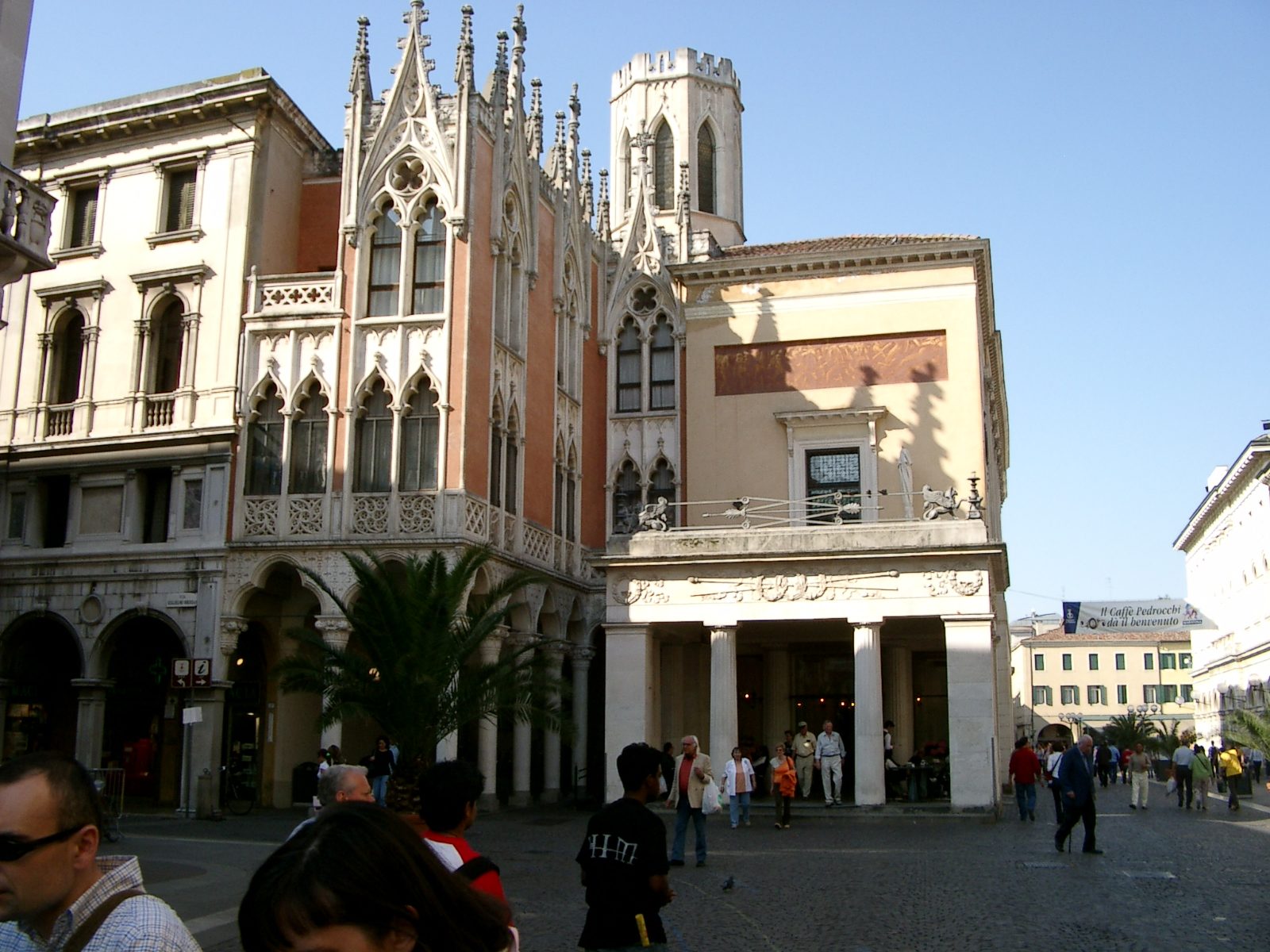
From a modest coffee shop to a landmark
The Pedrocchi family's coffee business in Padua began in 1772, when Francesco Pedrocchi, a merchant from Bergamo, opened a shop in the city. His son Antonio inherited and expanded the business from 1800, and in 1826 commissioned the architect Giuseppe Jappelli to redesign the premises on an ambitious scale. The ground floor opened to the public in 1831, and the neo-Gothic pastry pavilion known as the 'Pedrocchino' was completed in 1839; the ornately decorated upper floor, the Piano Nobile, followed in 1842.
The 'café without doors'
Caffè Pedrocchi became known as the 'caffè senza porte' for remaining open day and night, seven days a week, until 1916, a practice that made it a refuge for students, travellers and anyone wanting company or conversation at any hour. On 8 February 1848, the café was the scene of a violent clash between university students and Austrian troops, an episode in the wider Risorgimento uprising against Habsburg rule; a bullet hole from the fighting is still visible in the Sala Bianca. Among its recorded patrons were Stendhal, who called it the best café in Italy, and later Lord Byron and Dario Fo. Antonio Pedrocchi's ambition was to compete with the grand cafés of the major European capitals, and the round-the-clock policy, unusual for the period, was central to that aim.
Jappelli's eclectic building
Giuseppe Jappelli's design combines a neoclassical exterior, with a Doric-columned facade at the meeting point of three streets, with a strikingly varied interior. On the ground floor, the Sala Bianca, Sala Rossa and Sala Verde, each named for its dominant colour, served the everyday business of the café; the octagonal Sala della Borsa completes this level. Upstairs, the Piano Nobile houses a sequence of period rooms decorated in different historical styles, including Etruscan, Greek, Egyptian and Moorish rooms, alongside the frescoed halls that now make up the Museo del Risorgimento. Jappelli conceived the ground floor and the Piano Nobile as two different registers of the same building: a working public café below, and a sequence of stylistically varied showrooms above, intended for balls, banquets and receptions rather than everyday trade.
From private bequest to public café
Antonio Pedrocchi died on 22 January 1852, having adopted Domenico Cappellato, the son of a former employee, as his heir. On Cappellato's own death in 1891, the café passed by his will to the city of Padua, which has owned it since, keeping the building in public rather than family or corporate hands for well over a century.
Caffè Pedrocchi today
The ground-floor rooms still function as a café, restaurant and pastry shop, serving the Pedrocchi speciality of coffee with mint and cream. The Piano Nobile now houses the Museo del Risorgimento e dell'Età Contemporanea, documenting Padua's history from 1797 to the present with a particular focus on the events of 1848, while its historic halls continue to host conferences, exhibitions and private events.